
Lesson 01 · 15 minutes
Why AI matters for a business your size
The case for AI in an SME: what the numbers say, where the advantage is, and why waiting is the expensive option.
Quick win this week. Have an assistant draft one email you have already written ten times. Edit it, send it, and time the saving.
You employ twenty people. You do not have an AI team, a data scientist, or a budget for exploratory technology. Somebody told you AI is the future, and somebody else told you it is hype. Both are partly right, so let us start with what the numbers actually say.
Across the industry AI projects I built and led at AI Singapore, we evaluated more than a thousand companies, and three hundred and fifty became projects. What stopped the rest was readiness: data that was not ready, a leadership team that was not aligned, a problem nobody had defined. We have assessed more than five thousand organisations with the readiness index I built, and most sit below AI Ready, Level 2, the level where the economics start working for a business your size. Adoption is no longer the question. Readiness is.
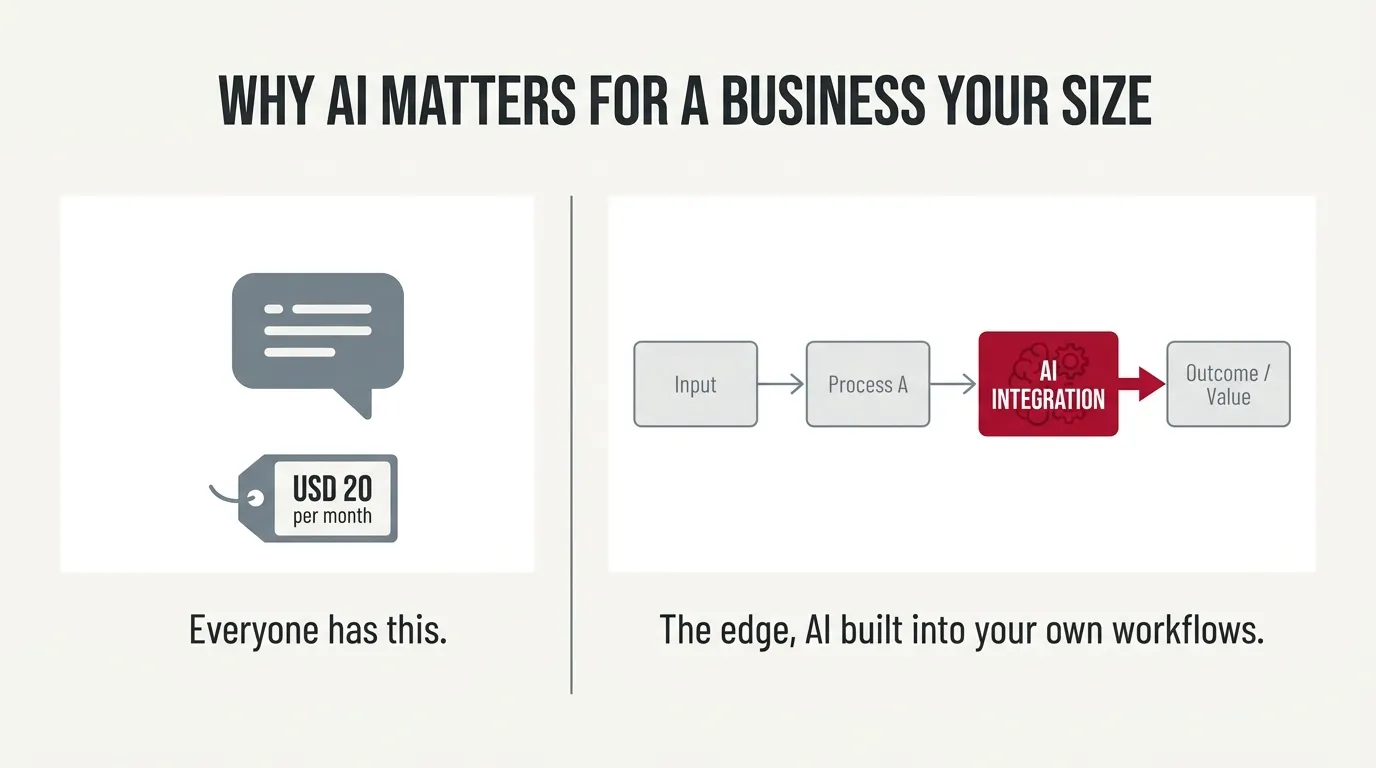
Here is the part that matters to you specifically. A chatbot subscription costs about twenty dollars a month, and it puts the same assistant in every one of your competitors’ hands. Your rivals use it to draft emails faster; so do you. Those gains cancel out. Tool use is the minimum now, necessary but not an advantage.
The advantage comes from the other thing: building AI into your own workflows, on your own data, around your own bottlenecks. A retailer that generates product descriptions from its own catalogue data, and a builder whose site reports write themselves from the foreman’s voice notes. Those are processes a competitor cannot buy off a shelf, because no off-the-shelf product knows your customers, your products, or your problems.
In the field: retail. A mid-sized retailer used AI to generate product descriptions from its own catalogue data and cut the turnaround for new listings from two days to same-day, lifting time-to-market revenue by an estimated twelve per cent. The tool was generic. The catalogue was theirs.
Small businesses have one structural advantage here that larger firms lack: you can decide on Friday and start on Monday. No steering committee, no procurement cycle, no eighteen-month pilot. In the project records I keep, SMEs move from decision to deployment faster than multinationals and government agencies, not because they are smarter, but because the owner’s attention is the whole approval chain. That speed is worth something only if you spend it on the right problem, which is what the rest of this course is about.
One more thing: the numbers can also convince you to do nothing, and that is the other failure mode. The organisations that concluded “AI is not for us” after one stalled project were almost never wrong about the technology. They were wrong about their starting point. They bought a project before they knew their own readiness level. That mistake is avoidable, it takes fifteen minutes to avoid, and the next two lessons show you how.
Try this. Before the next lesson, write down the one task in your business that eats the most hours for the least joy, the thing you or your staff postpone. Do not evaluate it. Just name it. You will use it in lesson eleven.