
Lesson 05 · 12 minutes
The AIRI Decision Engine
How to score a candidate AI project before spending money: the DE formula, why people count double, why data outweighs infrastructure, and why ethics is a gate, not a score.
Quick win this week. Take the AI project your team is most excited about and score it on the five AIRI pillars, one to five each, before anyone spends a dollar. The number changes the conversation.
The previous lesson introduced the five pillars of AIRI. This lesson scores a candidate project against them. The AIRI Decision Engine (AIRI DE) is the scoring method: it turns five judgements into one number that says whether this project deserves money now, later, or never. It is apolitical. A low score is not a rejection, it is a roadmap that names the pillar to fix first.
The formula.
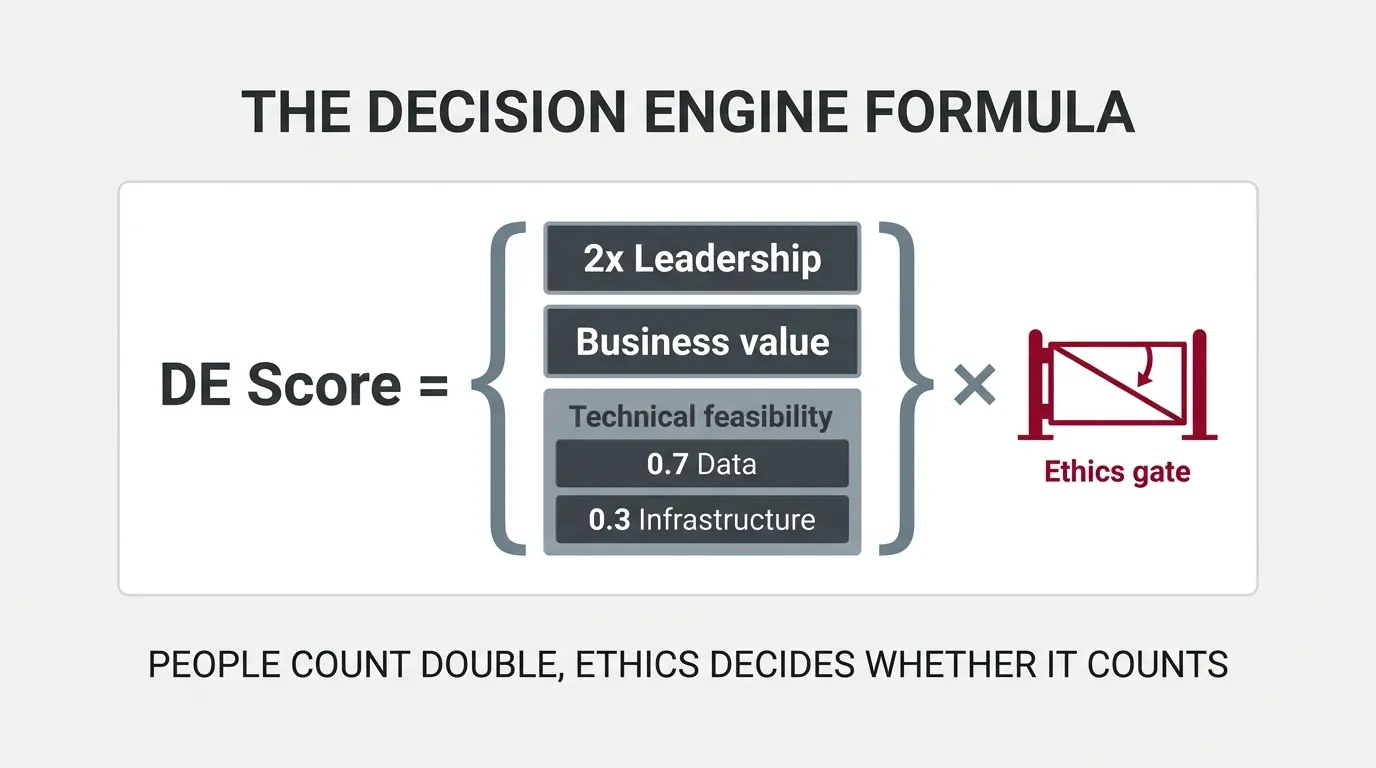
DE Score = [(0.7 × P4 + 0.3 × P5) + P3 + 2 × P1] × P2 Ethics Gate
P1 is leadership and culture. P2 is ethics and governance. P3 is business value. P4 is data foundation. P5 is infrastructure and standards. Score each pillar one to five against its AIRI rubric, then multiply. The maximum is twenty.
The weights. Every weight comes from what the records show.
- 2 × P1, Leadership & Culture. People count double. We curate projects before we approve them, so outright failure is rare: every project reached signoff except one, and we terminated that one ourselves. But around thirty per cent of completed projects did not deploy, and the cause usually traces to leadership and culture: the sponsor who went quiet, the team that never had the skills, the change nobody managed. Data and infrastructure rarely play a part, because we verified both before the project was approved.
- P3, Business Value. Full weight, no discount. Return on investment is the point of the exercise. A project that cannot name the number it will move, in revenue or cost or hours, is not a project yet.
- 0.7 × P4, Data Foundation. You can rent computing in an afternoon. You cannot rent your own data. A strong platform cannot rescue missing data, so data carries more than twice the weight of infrastructure.
- 0.3 × P5, Infrastructure & Standards. The platform you can buy. It counts, but it cannot start the project on its own.
- P2, Ethics & Governance. A gate, not a weight. It multiplies the whole score: ×1 with a basic policy in place, ×0.5 with informal guidance only, ×0 with no governance at all, and zero times anything is zero. Ethics does not trade off against value. It decides whether the conversation continues.
The anti-pattern: the hundred-POC hackathon. Some organisations skip all this with volume: a hundred proofs of concept in a hundred days, and hope something sticks. It does not work. Everyone builds something to make the boss happy, most of it never reaches production, and ninety days later the scoreboard shows activity and zero running systems. The Decision Engine exists for the opposite move: score your candidates, pick the one that clears the bar, and carry it to production.
The deployment guide on this site is the worked version of this lesson: the pillar rubrics, the four-line calculation, and the ethics gate, all on one printable sheet. Lesson eleven walks you through it, page by page.
Try this. Write down your top three problem statements and score each on the five pillars, one to five, with the people who will live with the result. Apply the formula. If the winner scores below ten, the score is telling you which pillar to fix before any project deserves money.