
Lesson 03 · 15 minutes
Measure before you spend
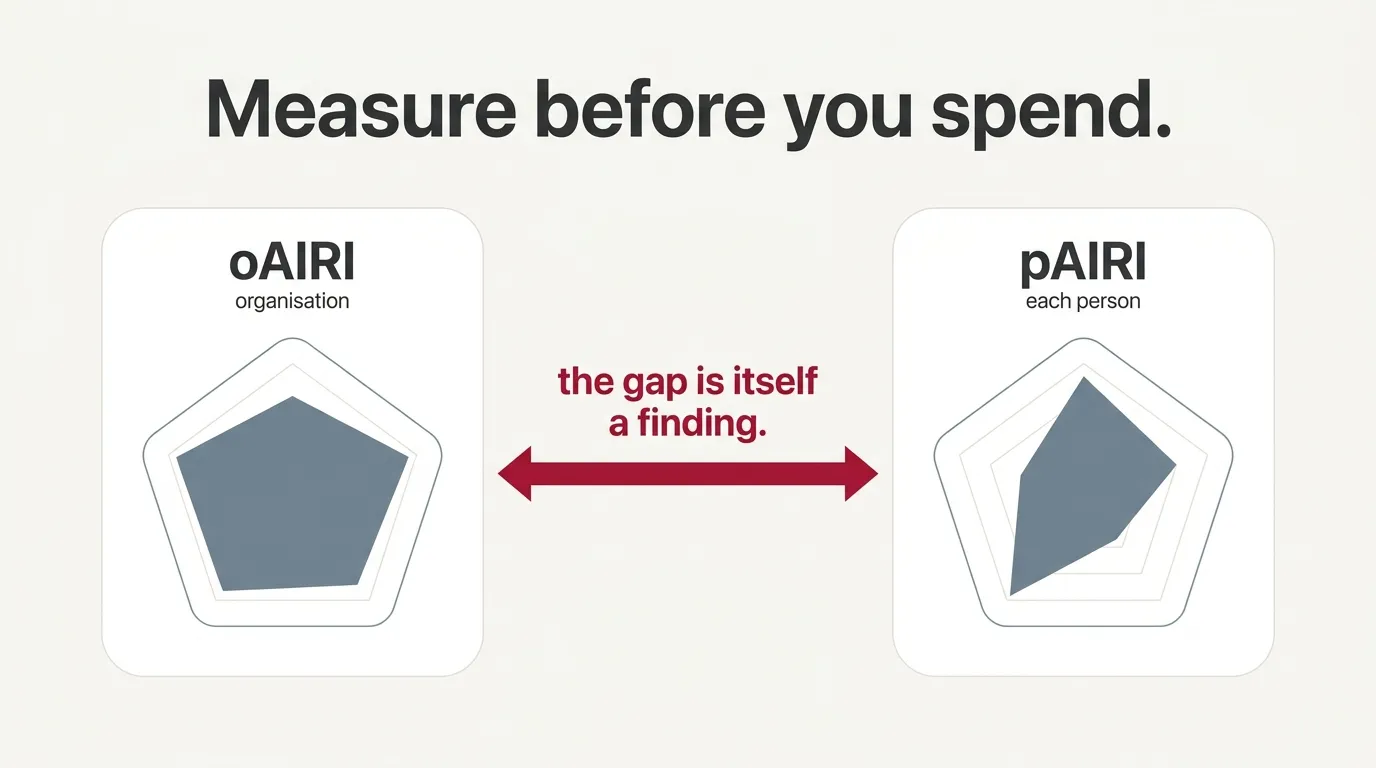
How the free AIRI assessment works, with two instruments of fifteen minutes each, and why the gap between your people and your organisation is itself a finding.
Quick win this week. Send the assessment link to two colleagues tonight and compare levels over coffee tomorrow.
You cannot transform what you cannot measure, and the cheapest mistake in AI is the project bought before the measurement. So before you spend a dollar on building anything, run the assessment. It is free, it takes about fifteen minutes, and it does not require preparation or an account.
There are two instruments, and you run both.
oAIRI: the organisational assessment. Fifteen questions across five pillars: leadership and culture, ethics and governance, business value, data foundation, infrastructure and standards. Three to five senior leaders take it independently, not in a room together, because you want the honest spread, not the negotiated answer. When one director scores your data practices a two and another scores them a four, that disagreement is information.
pAIRI: the personal assessment. The same architecture pointed at an individual: how ready is each person, really, to work with AI. Everyone in the company can take it. The questions are behavioural: they describe observable behaviour rather than asking how you feel, so the answers do not drift into the optimism that ruins self-assessments.
Both instruments score on the five-level ladder from the previous lesson. Run together they produce the number neither produces alone: the gap between your workforce’s readiness and your organisation’s readiness. A workforce at Level 2 inside an organisation scored at Level 0 means your people are ready for an initiative your leadership has not planned. The reverse, enthusiastic leadership above an unready workforce, is the more common pattern, and it predicts stalled projects with uncomfortable accuracy. I have watched steering committees approve budgets that the shop floor had no capacity to absorb.
Two properties of the assessment are worth knowing because they drive everything downstream. First, the ethics and governance pillar acts as a gate: the overall level is capped at that pillar’s level, so weak governance visibly caps the whole score. An organisation that cannot say who is accountable for an AI decision is not ready, whatever its data looks like. Second, the questions reflect the agent era. They probe delegation (can you hand work to an AI and supervise the result), specification (can you describe a task precisely enough for a machine to execute), and trust calibration (do you know when to check the output). Those three skills decide who thrives over the next five years, at every level of the ladder.
The assessment runs on AIRI Hub, the assessment platform for this ecosystem, and this site’s own instance is at ai4sme-org.airihub.io. When you finish, your completion screen carries a code that opens the full sector use-case library on this site: three hundred and eight real cases across twenty-five industries, catalogued by effort band. The library is the reward for the measurement.
Re-assess on a rhythm: pAIRI whenever skills visibly move, oAIRI with your leadership team every six months. The point is not the score. The point is the decision the score lets you make about where to invest next.
Try this. Take the pAIRI assessment yourself today, fifteen minutes, no account. Note your level and your two weakest pillars. If you lead people, this is also your benchmark for reading the rest of this course.