
Lesson 13 · 15 minutes
Choosing a solution provider
Eight questions to ask an AI provider in your first meeting: the answers tell you who can deliver into production and who can only demonstrate.
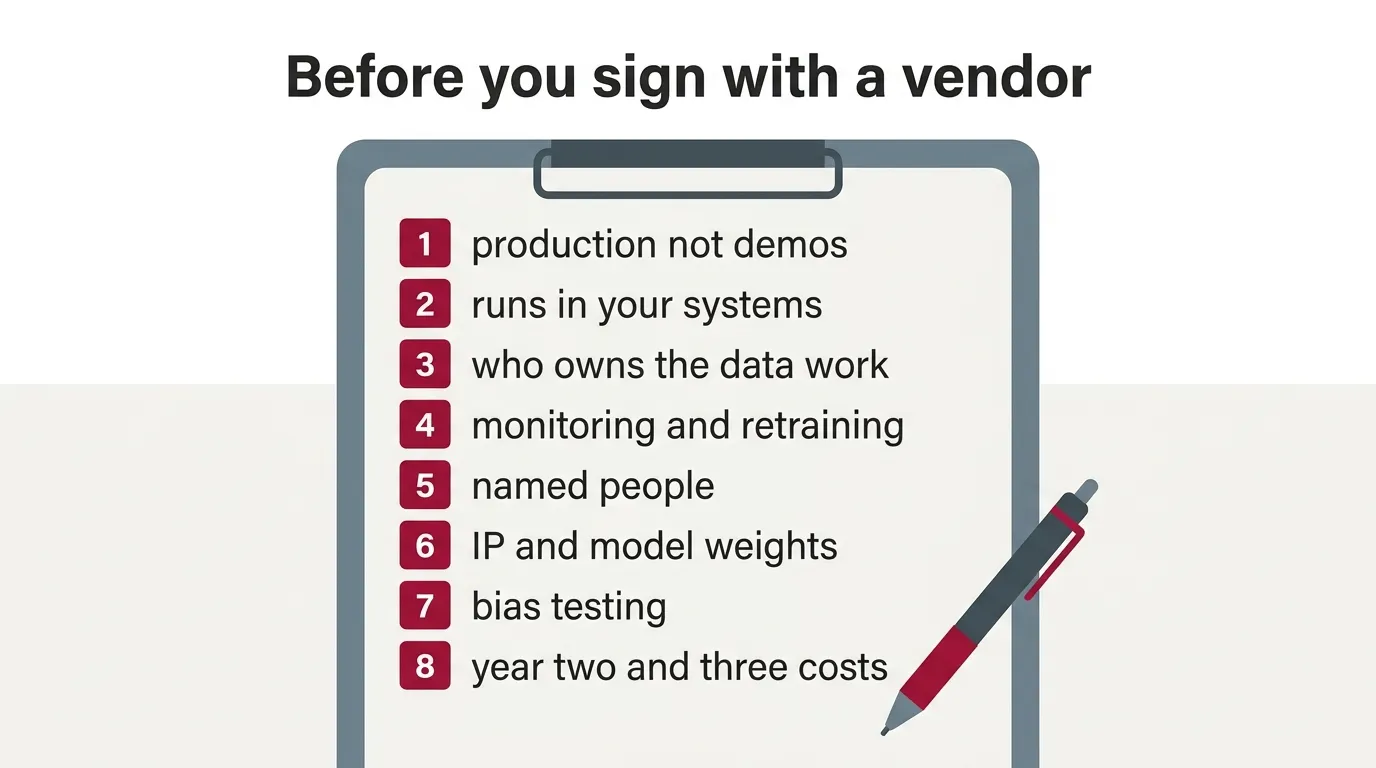
Quick win this week. Send the eight questions to a provider you are already talking to. Their answers, or their silence, are free intelligence.
If you take pathway two, you will meet solution providers. Some are excellent. Some are agencies that rebranded last year, and the difference is invisible in a pitch deck. The separation happens under eight questions, and they work because they are not about AI at all. They are about delivery.
Ask these in the first meeting. Take notes. The answers you get, compared across providers, are the whole evaluation.
- Delivery track record. How many AI solutions have you delivered into production, running in the client’s systems and used by the client’s staff, and can I speak to those customers? A provider who answers with demo count instead is telling you what they sell.
- The production bar. Will the deliverable run in my systems, behind my login or my API, or will I receive a notebook? Insist on the former, in writing, in the statement of work.
- Data work. Who handles data acquisition, cleaning, and ongoing maintenance, and how is quality sustained after handover? If the answer is “you, the client, somehow,” price that in.
- Monitoring and retraining. How will you monitor the live model, and what triggers a retrain? An unmonitored model drifts, and drift turns a success story into next year’s incident.
- The team. Who specifically works on my project, and what have they shipped, as distinct from researched? Credentials move decks; shipping moves businesses.
- Intellectual property. Who owns the IP, the data, and the model weights when we part ways? The answer is you.
- Ethics and governance. How do you test for bias, handle sensitive data, and manage the risk of AI agents acting without a human checking? This is not compliance theatre; the assessment caps your readiness score on this pillar for a reason.
- Total cost of ownership. What does running this cost in year two and year three? Not building it; running it. Models need hosting, licences, monitoring, and occasional surgery. The build quote is the small number.
A provider that answers all eight in detail, with names and numbers, is selling a deployed capability. A provider that answers with enthusiasm is selling you a model. Choose accordingly, and notice that questions two, four, and six are the production bar, the drift defence, and the ownership clause from earlier lessons, restated for the meeting room.
Two more habits complete the defence. Reference calls over case studies: speak to two past clients at your scale, and ask them what happened after go-live. The third month tells you more than the launch. Small scope first: if the engagement is large, cut the first tranche to something that can reach production alone, and let the provider earn the rest. You learn more from one delivered slice than from three contracted phases.
And when something feels wrong but you cannot name it, return to the evidence from lesson ten: across three hundred and fifty delivered projects, the ones that moved a number ran inside whole workflows. Whole workflows need a provider who can ship. The odds are not luck. They are the eight questions, asked early.
Try this. Print the buy page of the deployment guide you downloaded in lesson twelve, and keep it in your meeting folder. The eight questions are there ready-made, with room for the answers. You will reach for the list the day a demo excites you, and that is exactly the day you need it.