
Lesson 06 · 15 minutes
Your first ninety days
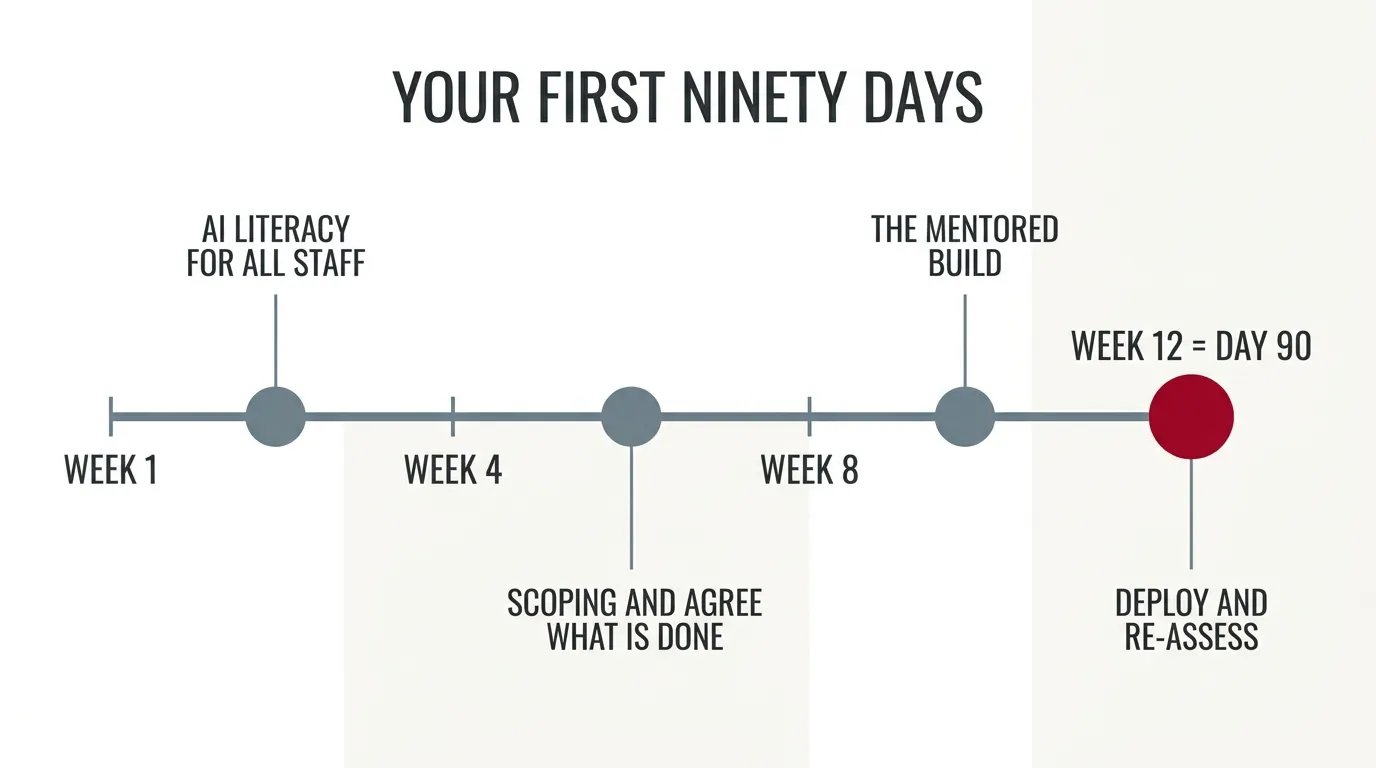
The four steps that take an SME from a readiness score to a running workflow in ninety days: AI literacy for all staff, scoping and agreement on what is done, a mentored build, and deploy with re-assessment.
Quick win this week. Put the project success definition in writing in one sentence: it must include how the AI project is to be deployed in your systems.
You have a score. Now what? The sequence below is the one I have watched work across hundreds of companies, compressed into the four steps that matter. It fits in ninety days: one month of AI literacy, one month of scoping, one month of build, then deploy and re-assess.
Step 1: AI literacy for all staff (weeks one to four). Everyone below AI Aware (Level 1) must get to AI Aware. Not by watching a video or attending a workshop, but by daily use of AI on their own work. Have each person pick one recurring task, whether quotations, enquiry replies, or summaries, and do it with an AI assistant for four weeks. The literacy that sticks is the one practised on real work, and it costs only the subscription. A free course for the general public lives at hokkien.me if you want something your family or non-technical staff can start with; otherwise your choice of AI tool often comes with free training and courses.
Step 2: scope the project and agree what is done (weeks four to eight). Choose the use case from your bottleneck, not from a vendor’s brochure; lesson eleven gives you the selection method. Then hold the scoping discussion: your leadership team and the programme’s mentors, working through the problem statement, the data that already exists in your business, and the fixed end date. Close the scoping by agreeing in writing what counts as done: the result runs inside your systems, used by your staff. A demonstration in a Jupyter notebook does not count. A slide does not count. This single rule is what separates the SMEs with running AI from the SMEs with slideware.
Step 3: build (weeks eight to twelve). One project, real problem, about one month of part-time development, with your own people doing the building and an experienced AI engineering team mentoring them, on your own data, with the intellectual property staying with you. The end date is fixed, so your exposure is capped by design. If it works you productionise; if it does not you have bought an education for the price of a pilot.
Step 4: deploy and re-assess (week twelve, which is day ninety). Deploy the result into your systems, behind your login, used by your staff. Then re-assess: pAIRI for the people who worked the project; oAIRI for the leadership team. Two questions: did the workflow reach production, and did the readiness distribution move? If both answers are yes, pick the next bottleneck. If either one is no, the post-mortem is almost always in steps two and three: the wrong problem, or the missing agreement on what is done.
The order is important. Literacy before scoping, because an unready workforce cannot spot the right problem. Scope and agreement before build, because retrofitting a demo into production almost never happens. One project before a portfolio of projects, because the second project is chosen ten times better than the first.
In the field: construction. A construction firm applied steps one and three to the least-loved task on any site: documentation. AI-generated meeting minutes and site reports cut documentation time by sixty to seventy per cent, and captured the action items manual notes were silently dropping. No new headcount; the firm’s own people run it.
Ninety days, four steps, one running workflow. Part two of this course gives you the working knowledge of AI: what AI actually is, what it can and cannot do.
Try this. Open your calendar and block the two decision dates now: the day the scoping is agreed and signed off (end of week eight) and day ninety for the re-assessment. Decisions without dates are intentions.