
Lesson 14 · 15 minutes
Making it stick
The measurement rhythm that keeps AI adoption alive after the first project: three metrics, a six-month cadence, and the destination restated.
Quick win this week. Print the progress tracker from the back of the deployment guide and fill the day-one column tonight: three metrics, one owner.
A programme that is not measured drifts, quietly at first and then completely. The staff AI subscription lapses, the workflow reverts to the old spreadsheet, and in a year the story becomes “we tried AI.” The antidote is a small set of metrics on a fixed rhythm, and this lesson is that set. There are three.
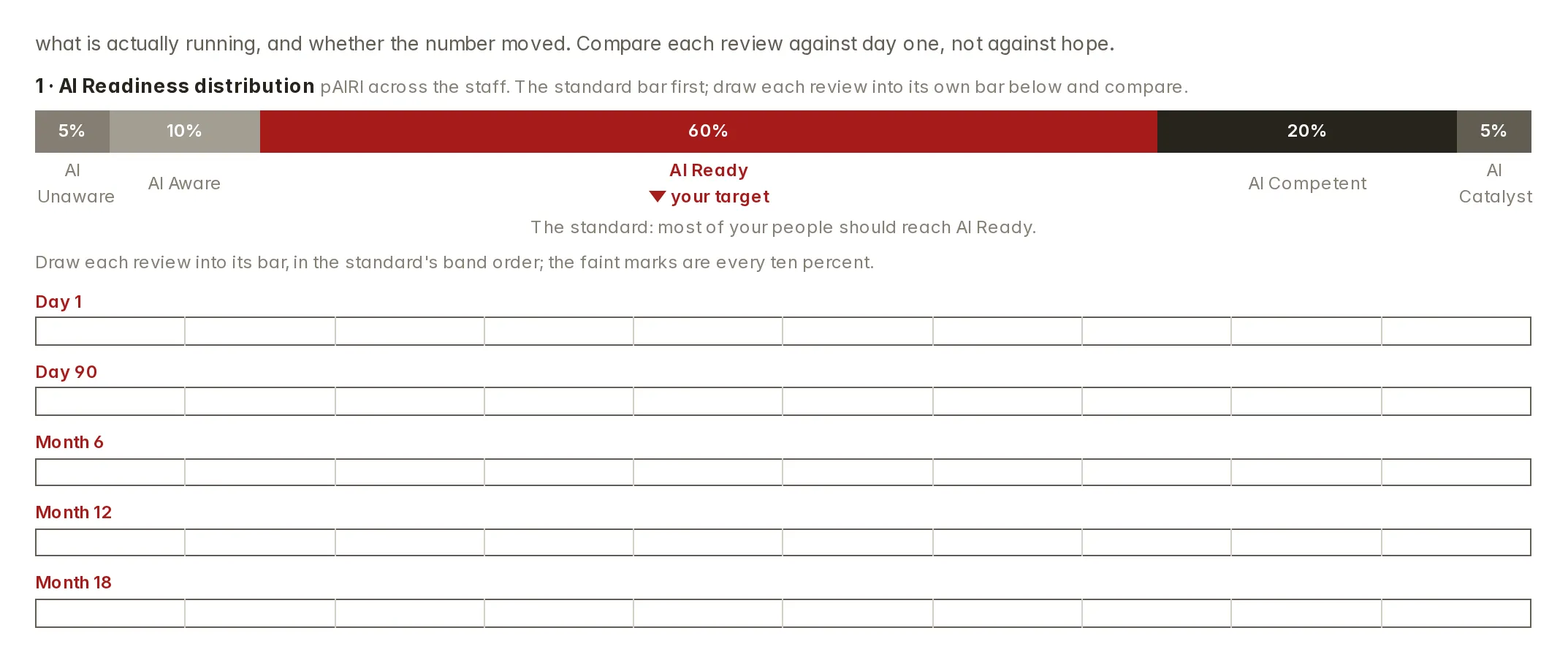
One: the readiness distribution. Where your people sit on the five levels, measured by pAIRI across the staff. The direction that matters: the share at Level 2, AI Ready, growing toward roughly six in ten, with AI Unaware heading for zero. You are not trying to make everyone a specialist. You are trying to make readiness the norm.
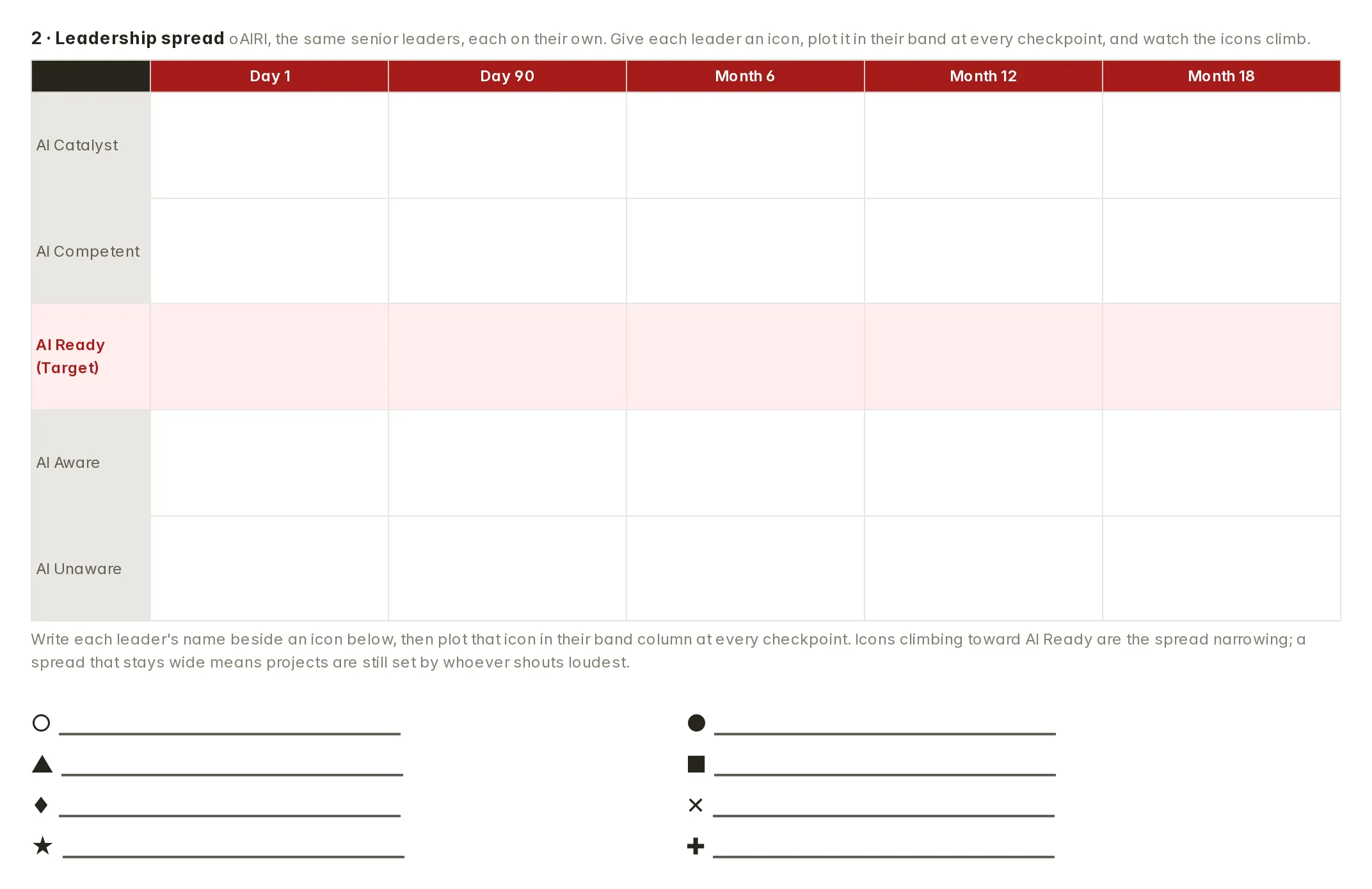
Two: the leadership spread. The gap between your senior leaders’ oAIRI scores, re-run every six months with the same people answering independently. A spread that narrows means the leadership team is converging on a shared, realistic picture. A spread that stays wide means your projects are still being set by whoever shouts loudest.
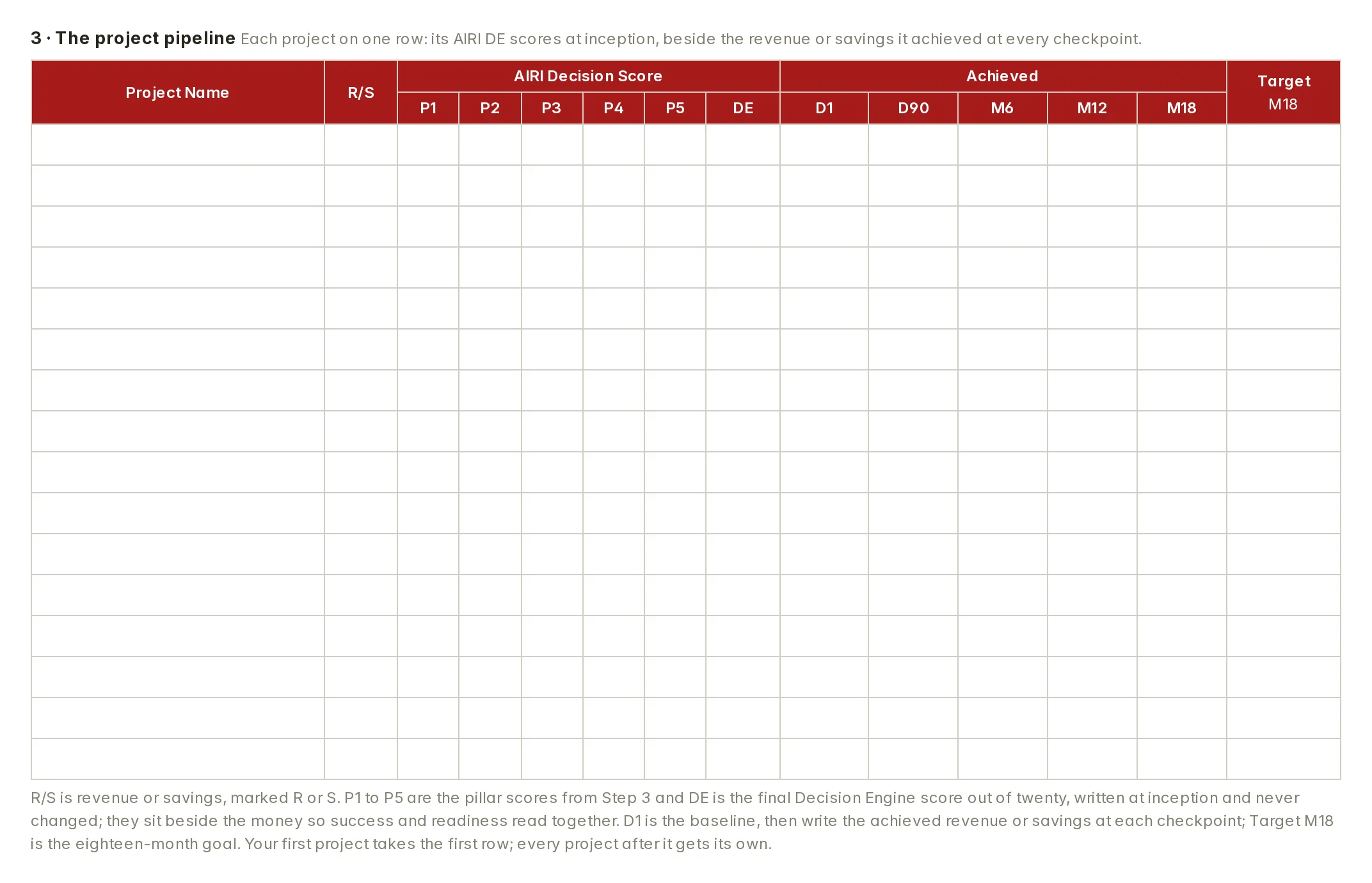
Three: the project pipeline. What is actually running, and what it moved: one table, tracked together. Each project takes one row, carrying its AIRI Decision Score at inception beside the revenue or savings it achieved at every checkpoint, with the month-eighteen target at the end. An entry at a checkpoint means the workflow is running in production, behind your login, and the number moved; a pilot still shows empty columns. One running workflow that survives staff turnover is worth five pilots that died in demonstration. Tie every project to exactly one number at inception, from lesson eleven’s one-liner: quotation turnaround, hours on documentation, conversion on the review platforms. At each review, count filled rows, not pilots started.
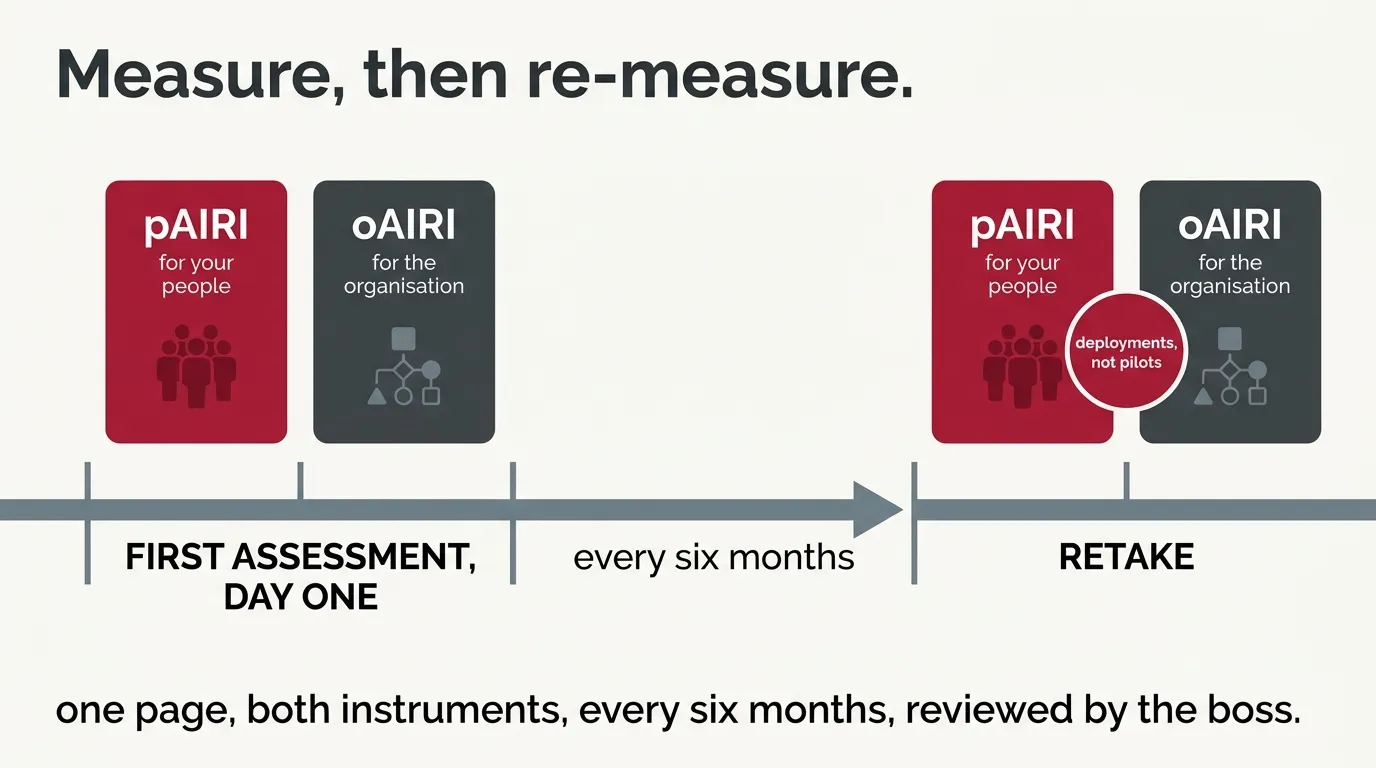
The cadence: day one is the day of your first AIRI assessment, before any project runs, and the ninety-day build sits inside the first six months. pAIRI when skills visibly move, at least twice a year; oAIRI every six months with the leadership team; the pipeline register on the same six-month rhythm, in one page, reviewed by the boss. Not a dashboard programme; one page. The point of measurement is not the score; it is the decision the score lets you make about where to invest next.
Around the metrics, three habits keep adoption alive between reviews. The boss uses the tools visibly, because nothing kills a rollout faster than leadership that exempts itself. Every completed project ends with the question “what did we learn that the next project needs?” The compounding pathway from lesson twelve depends on it. And when something fails, run the post-mortem against the four steps from lesson six; in my records the failure is almost always in the selection, the scope, or the missing success definition, not in the technology.
That is the course. Restated in one breath: measure where you stand, aim for AI Ready rather than an in-house AI team, learn what the technology actually does and where it fails, pick one real bottleneck on existing data, build with help under a production bar you own, vet providers on delivery, and re-measure every six months. The destination for a business your size is not to become an AI company. It is to be a company whose ordinary workflows run well, with your people at Level 2, your judgement in the loop, and your competitors still reading about it.
Where next: re-assess at ai4sme-org.airihub.io, browse the full use-case library on this site for your sector, and if you want a gentler on-ramp for family or staff, the public course at hokkien.me explains the AI over a plate of fried hokkien mee. Then pick your bottleneck. Ninety days from now, your first workflow can be running.
Try this. Book the six-month review in your calendar now, the one with the oAIRI re-run and the one-page scorecard. Adoption programmes die of calendar neglect more often than they die of failure.