Lesson 07 · 15 minutes
What AI actually is
AI stripped of the movies and the marketing: prediction from patterns, learned from examples, with nothing inside it that knows or wants.
Quick win this week. Pick one decision your business makes on instinct and find where its history sits: a spreadsheet, an inbox, a logbook. That is a prediction problem scoped.
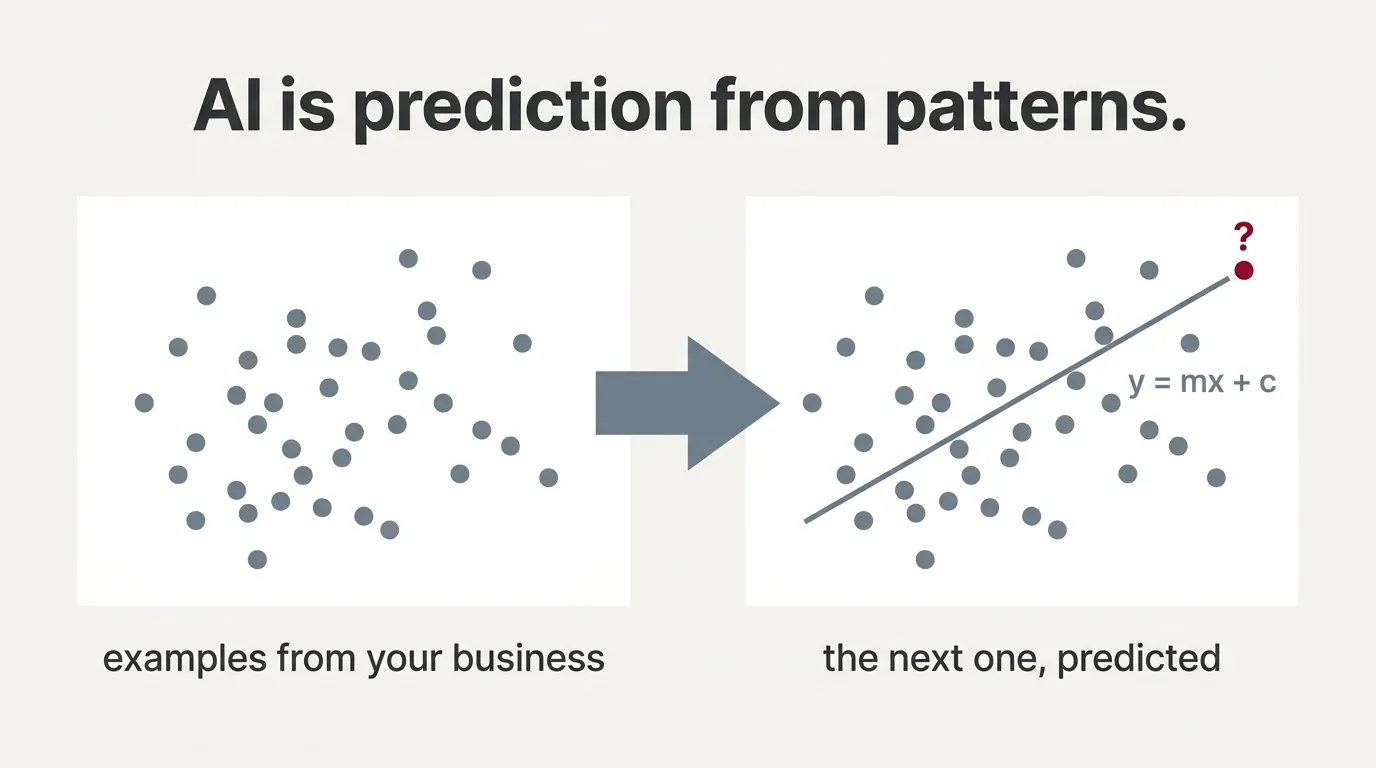
Strip away the movies and the marketing, and artificial intelligence is one thing: a system that makes predictions from patterns in data. It has seen many examples, and when you show it something new it plays the odds. That is the entire trick.
Your phone suggests the next word because it has seen the words that follow yours a few million times. A bank flags a transaction because it resembles, in dozens of small ways, transactions that previously turned out to be fraudulent. Nobody wrote a rule that says “flag this.” The system learned the boundary from examples, which is why the field is called machine learning, and why the examples matter more than the code.
This has three consequences for you as a business owner, and they explain almost every AI success and failure you will meet.
First: AI is only as good as its examples. A model trained on clean, representative data of your actual business performs small miracles. The same model pointed at messy, partial, or outdated data produces confident nonsense. When people say the project failed because “the data was not ready,” this is the sentence they are compressing. It is why data foundation is one of the five assessment pillars, and why lesson eleven insists on problems whose data already exists in your business.
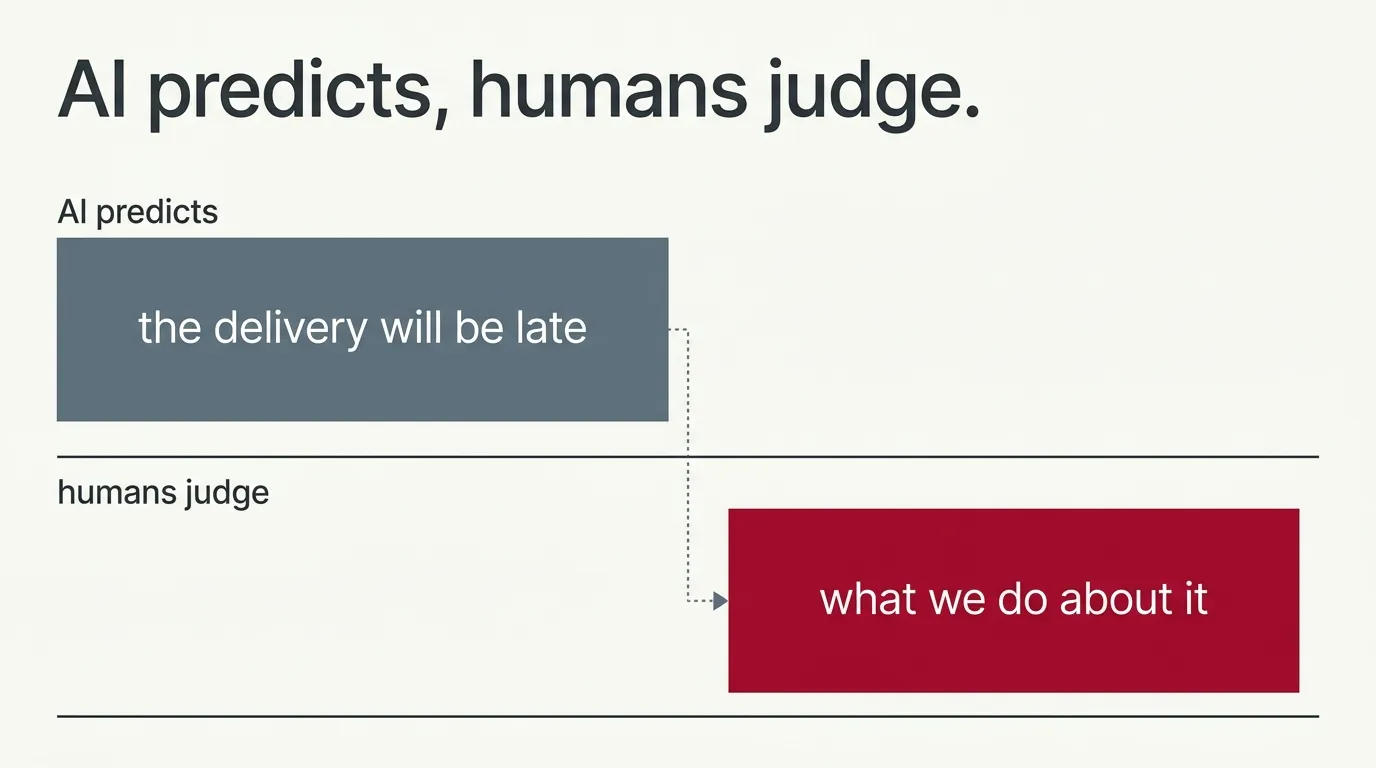
Second: AI predicts, humans judge. The system tells you the delivery will be late, the invoice looks wrong, the customer is likely to churn. It does not decide what to do about any of that, and it does not carry responsibility for the decision. Prediction has become cheap; judgement, knowing what matters, what the customer will tolerate, and what risk is worth taking, remains yours. The businesses that get value from AI are the ones that rearrange work around this division, not the ones that pretend the machine can be trusted with both halves.
Third: it is maths, not a mind. There is no understanding inside, no magic, no small person pulling levers. AI is maths, science, human judgement and a bit of art.
One clarification, because the words get used loosely. The public conversation about “AI” today mostly means generative AI, systems that produce text, images, and code, which arrived long after the pattern-prediction core and sits on top of it. Lesson nine covers that layer and the agents built on it. But the boring, older half of the family, the classifier that sorts and the model that forecasts, is where most SME value still lives, and it is where the next lesson takes you.
In the field: aerospace. Maintenance engineers used to spend thirty to forty-five minutes hunting through 10,000-page manuals for a torque specification. An assistant trained on those manuals answers the query in about two minutes, with the source reference attached. The manuals were the examples; the examples were already there.
Try this. Pick one decision your business makes repeatedly on instinct: credit terms, restocking, lead scoring. Ask yourself: what examples of past outcomes exist, and where do they sit? You have just scoped a prediction problem.