
Lesson 12 · 15 minutes
Build, buy, or grow your own
The three engagement pathways for an SME, subscribe and configure, grow your own people through mentored training, or bring in a collaborator for the complex project, and how to choose between them.
Quick win this week. Give your domain expert one month of an assistant subscription and one real task. The capability test costs less than a team lunch.
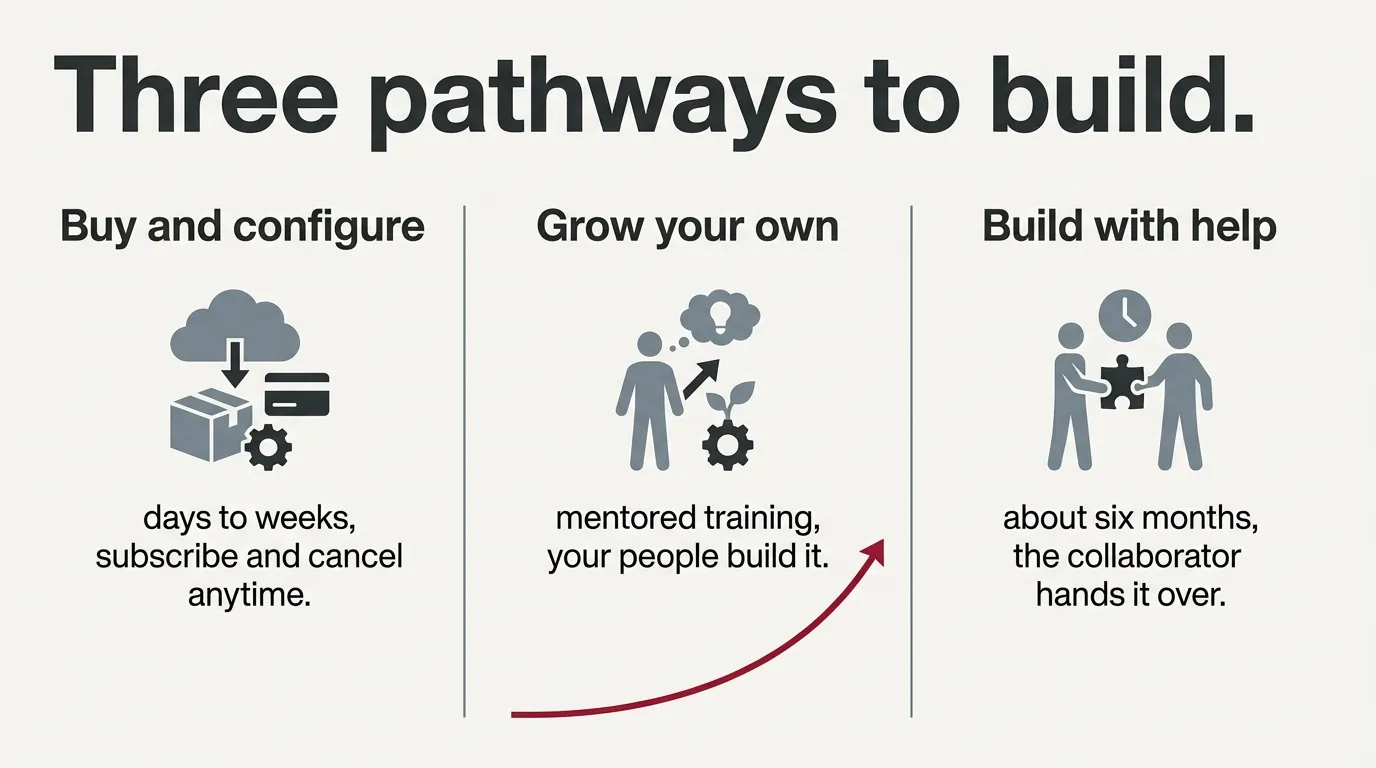
With a project one-liner in hand, the question becomes who builds it. There are three pathways, and the honest answer for most SMEs is a sequence: buy first, grow your own second, and bring in a collaborator only when the project is complex.
Pathway one: buy and configure. For quick wins, somebody has already built the tool. You subscribe, point it at your documents or your templates, and configure. This is how the first workflow should almost always ship: days to weeks, no consultants, cancellable monthly. The strategic limit is that everyone can buy the same tool, so this pathway delivers productivity, not advantage. It is the floor, not the ceiling.
Pathway two: grow your own. Send your people for training with mentorship. The programme that fits an SME best runs about one month of scoping and one month of part-time guided development: your own people, not consultants, build and deploy a real application for the business, with experienced AI engineers mentoring them throughout, and the intellectual property stays with you. The domain expert who has run your operations for a decade, given modern tooling and mentorship, can build internal tools no external vendor could, because the vendor never understood the process. The builders do not need a technical background; the tools and the mentorship carry the engineering. And watch what it does to the room. The team that builds its own tool is proud of it, uses it, and defends it, and the effect is viral: if finance can do it, so can HR. This pathway costs time and returns capability, and it is the only one that compounds. Your second and third workflows cost less than anyone’s first. See AI Singapore’s LADP.
Pathway three: build with help. For the complex project. When the work needs a custom AI model, computer vision, prediction, optimisation, something no amount of mentoring will get your team to in one pass, bring in a collaborator: a co-funded industry project, a fixed horizon of roughly six months, the collaborator’s engineers building alongside your people, and (this is the clause people skip) the intellectual property stays with you, and at the end you take the system over: your team runs it, maintains it, and owns it. Governments and agencies in many economies co-fund such programmes precisely because SMEs cannot carry project risk alone; ask yours what exists. Two rules keep the engagement safe at your size. The success definition, agreed in writing before the build starts: the deliverable runs in your systems, not in a notebook. The fixed horizon: the project ends on a date, so your exposure is capped by design. And because your own people work inside the engagement, you are growing the operators who will run it after handover. You entered for a solution; you exit with a solution and the team that can keep it running. See AI Singapore’s 100E.
The sequence I have watched work at small scale: pathway one in the first weeks to get literacy and a visible win; pathway two inside the first ninety days, your own people building one real workflow with mentorship; pathway three only when a complex project justifies it, and by then your people know enough to specify what done means. Skipping straight to pathway three before anyone internally can specify done is how you end up paying for a demonstration nobody in your company can run.
In the field: professional services. The pattern generalises: the firms that moved fastest ran meeting summarisation as a buy-and-configure win in month one, then pointed the same internally grown skill at engagement analysis a year later. The tool did not matter by then; the capability did.
Whatever pathway you choose, one clause is non-negotiable: you own the IP, the data, and the model weights when the engagement ends. If you do not own it, you are renting your own workflow. The day the contract ends or the price changes, the work stops.
Try this. For your one-liner from lesson eleven, mark which pathway fits today, not which one impresses. Then mark which pathway you want to be using in eighteen months. The gap between the two is your training plan.