
Lesson 08 · 15 minutes
The five things AI does
Classification, clustering, forecasting, computer vision, and generation: the complete list, each with a real SME use case.
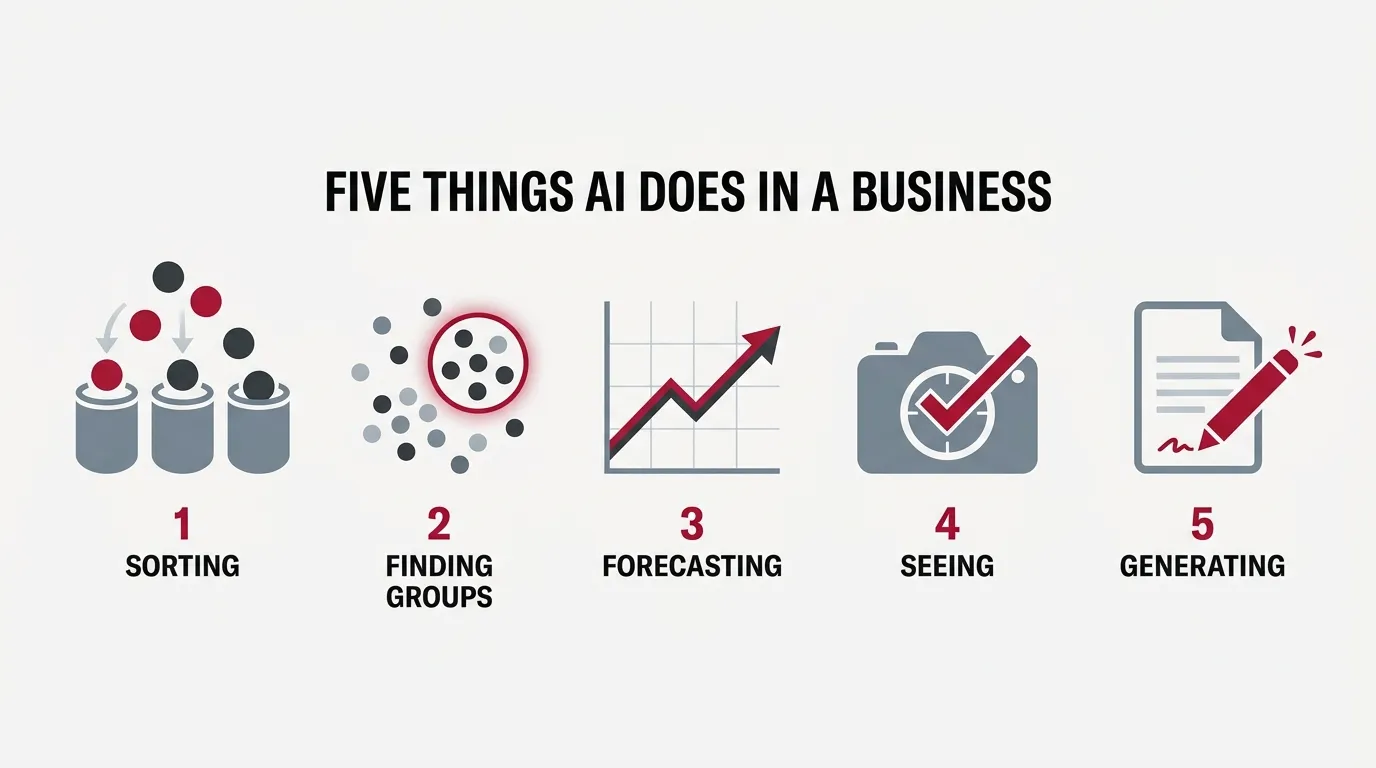
Quick win this week. Take the task you named in lesson one and determine if the task fits into one of the five categories in the image above. If it is none of them, it is judgement, so leave it to the humans.
Everything AI does in a business reduces to the five categories in the image above. Not fifty; five. Learn to name them and you will never again be sold something you cannot categorise.
Classification: sorting things into buckets. Spam or not spam. Invoice or receipt. Urgent enquiry or routine. The model has seen labelled examples and predicts the label for new items. This is the workhorse of back offices: triage, routing, compliance flags, quality inspection.
Clustering: finding the groups you did not know existed. No labels this time; the system groups things that resemble each other and hands you the segments. Your customer base falls into four behavioural clusters you never defined. Your fault logs cluster into families with a common cause. Clustering is how you discover structure, where classification applies structure you already trust.
Forecasting and prediction: the number that is coming. Next month’s demand, the machine that fails on Thursday, the lead most likely to convert. Every inventory and maintenance decision your business makes on gut has a forecasting version sitting on data you already collect.
Computer vision: seeing at scale. Defect detection on the line, counting stock from a camera, reading documents. Vision is classification with images as the input, and it is one of the most common AI use cases in many industries, because a camera and a labelled set of past defects is all the raw material it needs.
Generation: making new content. Drafts, descriptions, summaries, code. The newcomer, the loudest, and the one everyone mistakes for the whole AI field. The next lesson is entirely about it.
Now the useful part: mapping the five categories onto an SME’s actual week. Enquiries arrive: classify and route them. Customers behave in patterns: cluster them, then treat the segments differently. Stock and demand changes: forecast them. Something has to be inspected: show a camera. Something has to be written: generate the first draft, always as a draft.
In the field: logistics. A logistics firm applied classification to shipment tracking and customer queries: twenty-five to forty per cent of routine queries dissolved, support staff reclaimed two to three hours a day, and customers got instant answers around the clock instead of waiting for office hours.
In the field: manufacturing. A manufacturer used the generating category, the same technology behind the chatbot, on its own standard operating procedures and cut drafting time by sixty to seventy per cent, saving more than two hundred engineering hours a quarter on documentation alone. Same five categories; the value was in using the right technology to solve the right business problem.
When a provider pitches you, ask which of the five the product performs and on whose examples it learned. If the answer is a paragraph instead of a word, that tells you something too. The full sector library on this site catalogues three hundred and eight of these by industry and effort band; it is the same taxonomy, applied.
Try this. Take the task you named in lesson one and reduce it to one of the five moves. If it will not reduce, if it is genuinely judgement, relationships, or craft, good: now you know it is not an AI problem, and no vendor should be selling it to you.