Lesson 09 · 15 minutes
Generative AI and agents
How large language models work, what changed when they arrived, and the three skills that define working with them: delegation, specification, and trust calibration.
Quick win this week. Rewrite one poor instruction you gave this week as a proper specification, with inputs, format, rules, and exceptions, and hand it to an assistant.
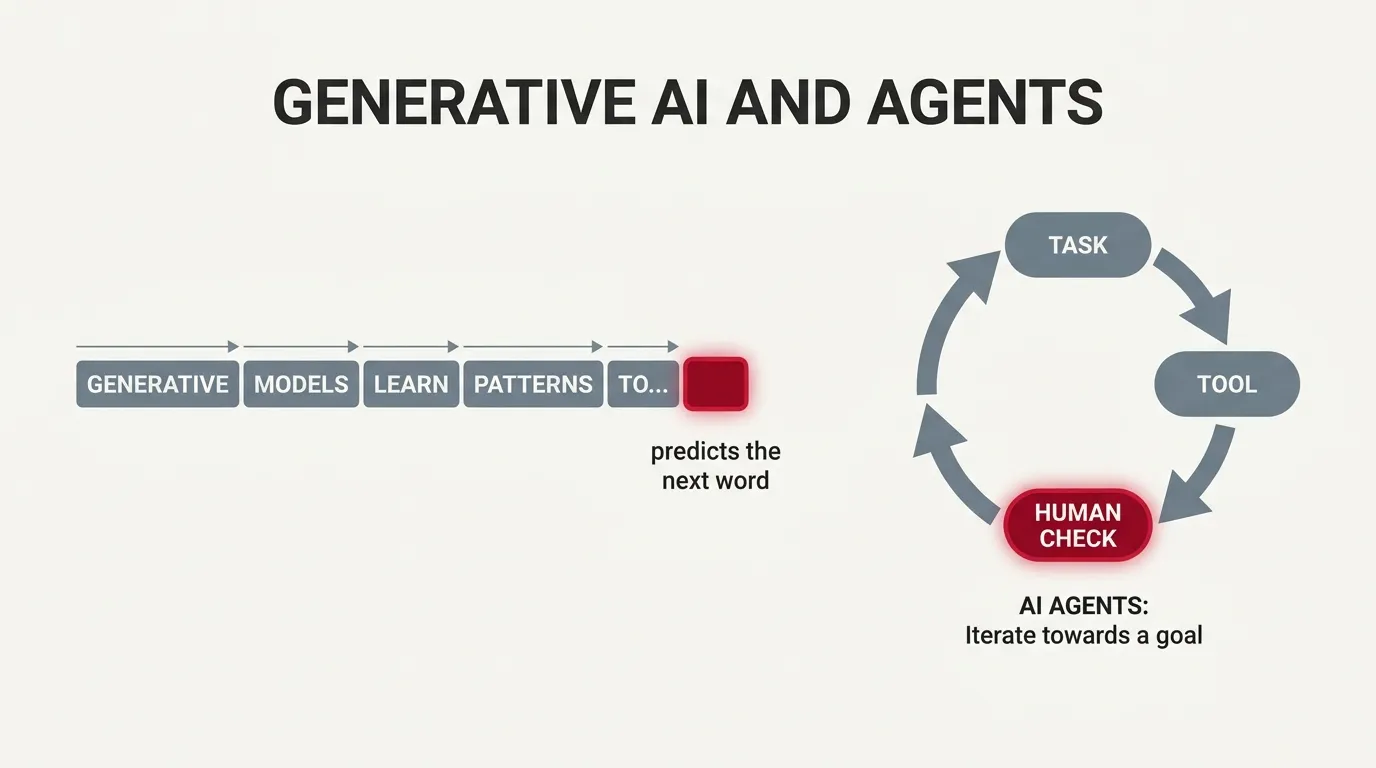
Everything in the first six lessons has been true since roughly 2015. What changed the world was the arrival of systems that generate fluent language: large language models (LLM), trained on a significant share of everything humans have written, that predict the next word so well the output reads like thought.
An LLM is still the prediction machine from lesson seven, pointed at text. Given your sentence, it predicts a plausible continuation, over and over, at speed, with enough nuance that the result drafts a contract clause or explains a regulation in plain English. Two properties follow directly from that mechanism, and internalising them is the difference between using these tools well and being burned by them.
They are fluent without being factual. The model’s job is plausibility, not truth, and a confident fabrication reads exactly like a verified fact. They are generic by construction. They learned from everyone’s data, so they know what an average business would do. The value appears only when you ground them in yours: your documents, your numbers, your voice.
The newest layer is the agent: an LLM given tools and a multi-step job. You say “reconcile last month’s deliveries against invoices and flag mismatches over five hundred dollars,” and it reads the spreadsheet, queries the records, applies the rule, and produces the exception list. The prediction machine can now execute a workflow, not just describe one.
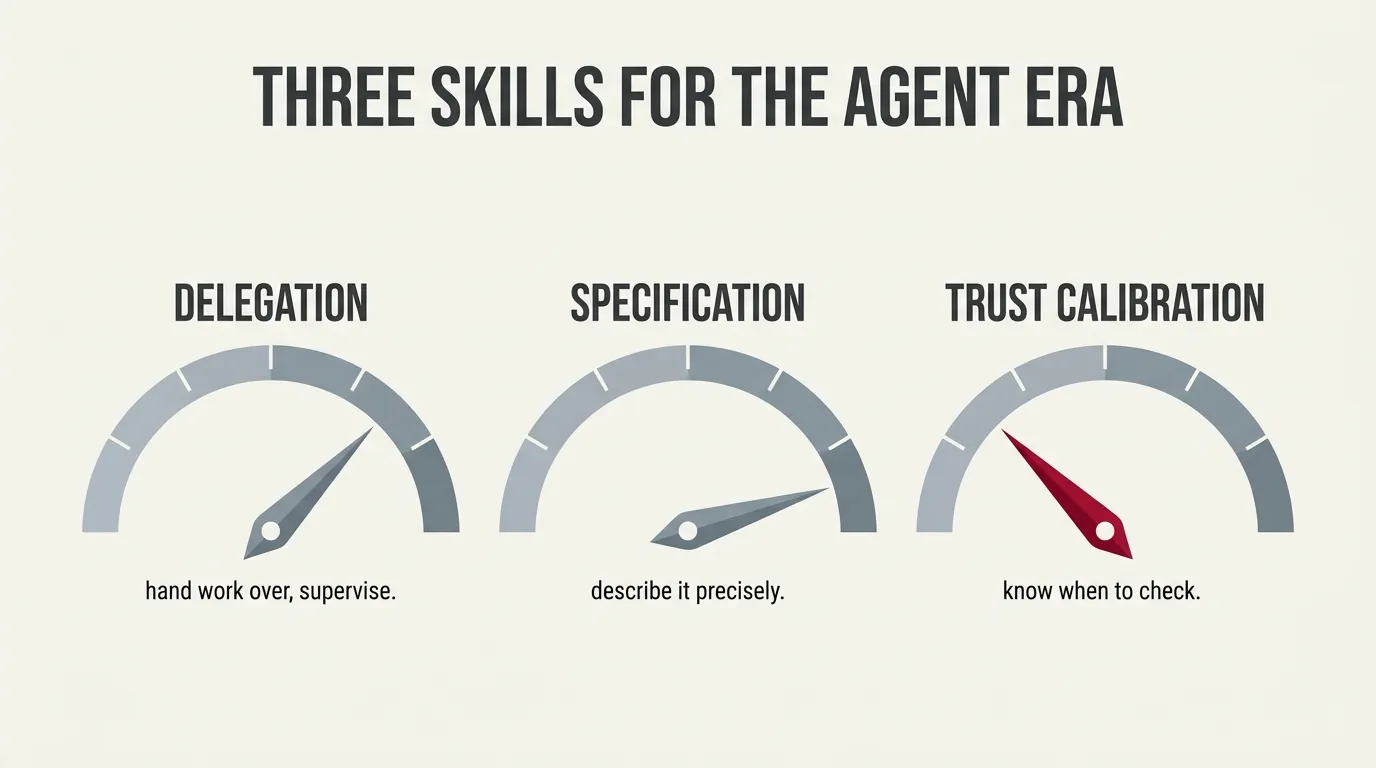
Working with agents changes the skill profile, which is why the assessment you took probes exactly three competencies.
Delegation: the willingness to hand work over and supervise the result. The managers who struggle are not the ones who lack technical skill; they are the ones who cannot let go of doing it themselves, or who hand over and never look again. Delegation means both.
Specification thinking: describing a task precisely enough for a machine to execute it well. The difference between “clean up my customer list” and “for each duplicate pair, keep the record with the more recent purchase and merge the notes, flag anything ambiguous for me” is the difference between unusable and useful. This is the defining skill of the agent era, and it is learnable: every task you specify for a junior staff member is practice.
Trust calibration: knowing when to check the output. Low-stakes draft: skim. Client-facing number: verify at the source. Agent writing to your customers: review before it sends, then audit a sample forever. Calibration is a dial you set per task, and the assessment measures whether you know where yours sits.
In the field: healthcare. Clinicians used generation for clinical documentation drafting and saved one to two hours per clinician per day, with the note that the clinician signs the note. The drafting was delegated; the judgement and the accountability stayed human. That division is the pattern to copy in your business.
Try this. Take one recurring written task and write the specification you would hand a competent new hire: the inputs, the format, the rules, the exceptions. Then hand the same specification to an AI assistant. The gap between the two outputs is your specification skill, measured.